Yes, a coworking space is worth it for startups if you need to move fast, keep fixed costs low, and avoid locking cash into furniture, Wi-Fi setup, or a multi-year lease. For most early-stage teams in Jaipur, that “if” applies more often than not – but not always, and the exceptions matter as much as the rule.
As of 2026, WorkNest in Mansarovar has hosted more than 500 businesses through exactly this decision. Some outgrew a hot desk in months. Others stayed on a dedicated desk for years. The difference usually came down to three things: cash runway, team size, and how often the founder needed a fixed address clients could walk into.
This guide breaks down the real cost case, the flexibility case, and the specific situations where a traditional office still wins – using actual Jaipur pricing, not US-market averages.
The Cost Case
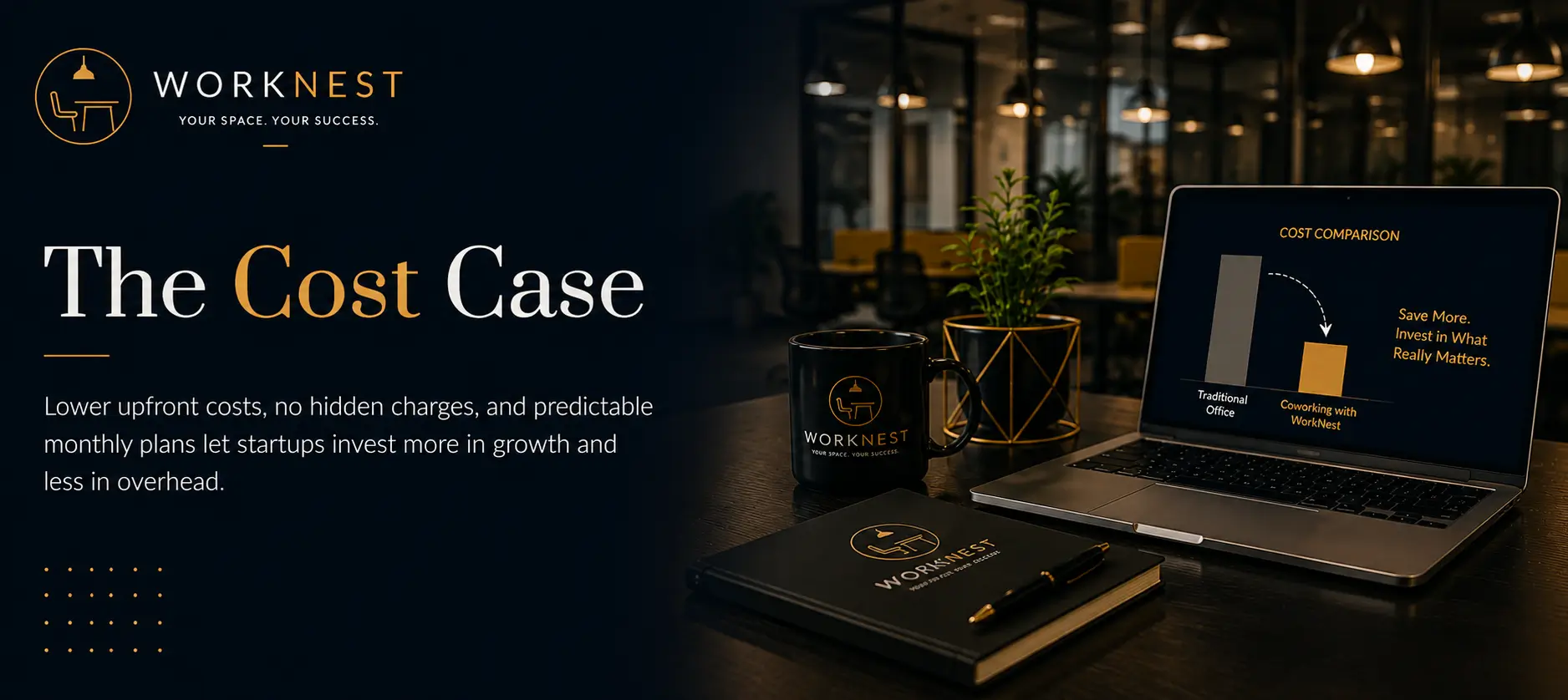
A coworking space for startups in Jaipur removes almost every upfront cost a traditional office demands. You’re not paying a security deposit, buying desks, wiring internet, or hiring someone to manage the pantry.
At WorkNest, the entry point is a Hot Desk at ₹699/day – useful for testing a location before committing further. Most early teams move to a Dedicated Desk at ₹9,999/month once they need a fixed seat. Teams that need a closed room for client calls or compliance-sensitive work choose a Private Cabin at ₹24,999/month. Meeting rooms are billed separately at ₹799/hour, so you only pay for client-facing space when you actually use it.
Compare that to a traditional small office in Mansarovar-adjacent commercial areas. Estimated – verify before publishing: a 400–500 sq. ft. commercial space typically runs ₹35,000–₹55,000/month in rent alone, before a refundable deposit (often 6–10 months’ rent), furniture, AC installation, internet setup, and a housekeeping or admin hire. For a 4-person startup, that can mean ₹1.5–3 lakh in upfront cash before day one – cash most seed-stage founders would rather spend on product or payroll.
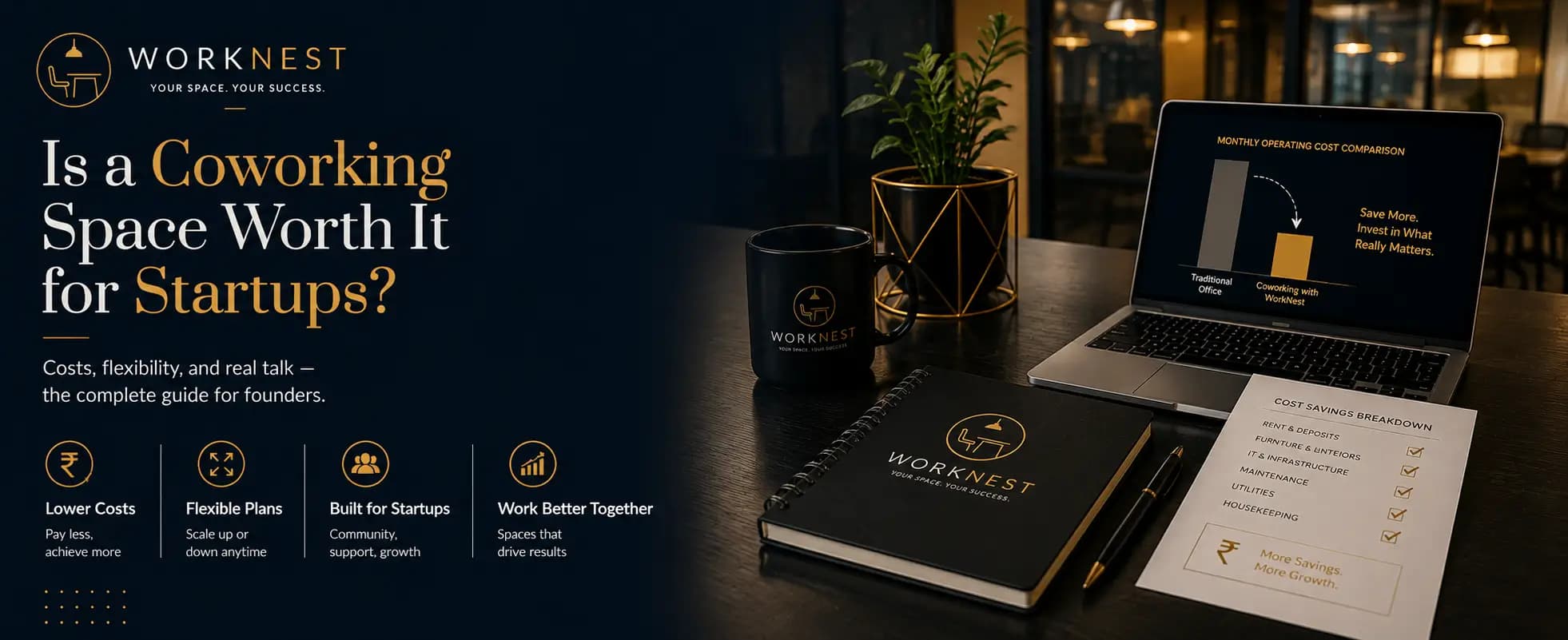
Startup office cost savings here aren’t marginal. A 4-person team on Dedicated Desks at WorkNest pays roughly ₹40,000/month total, with zero deposit and zero furniture spend. That’s the core of coworking ROI for startups: capital stays in the business instead of sitting in a landlord’s deposit account.
| Cost Component | Traditional Office (Estimated) | WorkNest Coworking |
| Upfront deposit | ₹2.1–5.5 lakh (6–10 months rent) | ₹0 |
| Furniture & setup | ₹1–2 lakh | Included |
| Monthly rent (4-person team) | ₹35,000–55,000 | ~₹40,000 (4 Dedicated Desks) |
| Internet, maintenance, admin | Separate hire/cost | Included |
| Meeting room access | Built into rent (fixed) | ₹799/hour (pay-per-use) |
| Minimum commitment | Usually 11-month lease | Monthly |
Table note: Traditional office figures are estimated averages for Jaipur commercial space and should be verified against current local listings before publishing.
The Flexibility Case
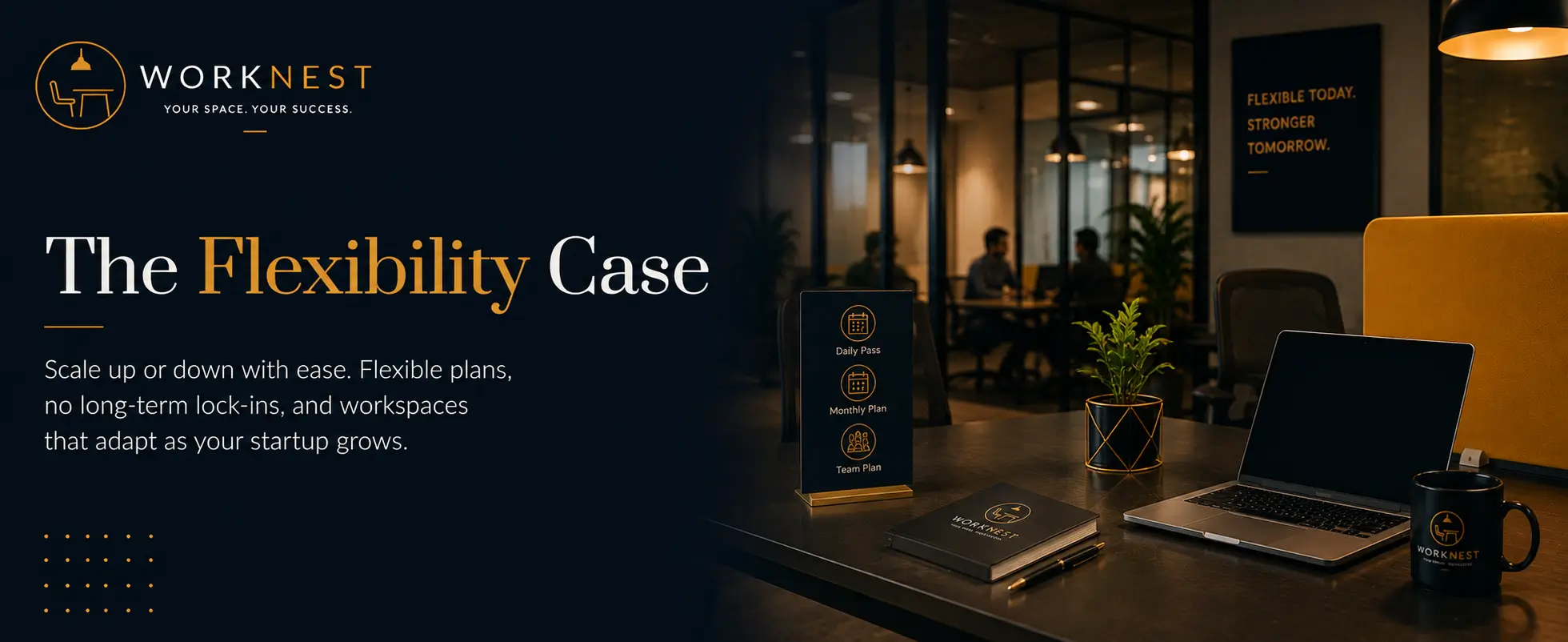
Cost is only half the argument. The bigger reason coworking wins for early-stage teams is that startup headcount rarely moves in a straight line.
A traditional lease locks you into one configuration for 11 months or more. If you hire five people in a quarter, you’re either cramped or paying for empty desks you signed up for a year ago. A coworking model lets you scale desk count up or down as hiring and revenue actually happen – which matters most in the first 18–24 months, when a founder genuinely doesn’t know if the team will be 3 people or 15 by next quarter.
This is when to get an office for a startup matters most: the moment your team size is still a forecast, not a fact. Flexible desks fit that moment better than a lease. WorkNest’s response time for account and booking queries is under 30 minutes. So scaling desk count up before a client visit or a new hire’s start date doesn’t need weeks of lead time, unlike a lease renegotiation.
There’s a trust signal worth noting too. WorkNest holds a 4.8 Google rating in Mansarovar, Jaipur, backed by more than 500 businesses served to date. It also has a 91% renewal rate among current members. That means the large majority of teams that try it choose to stay, rather than treating it as a stopgap.
When It Might Not Be Worth It
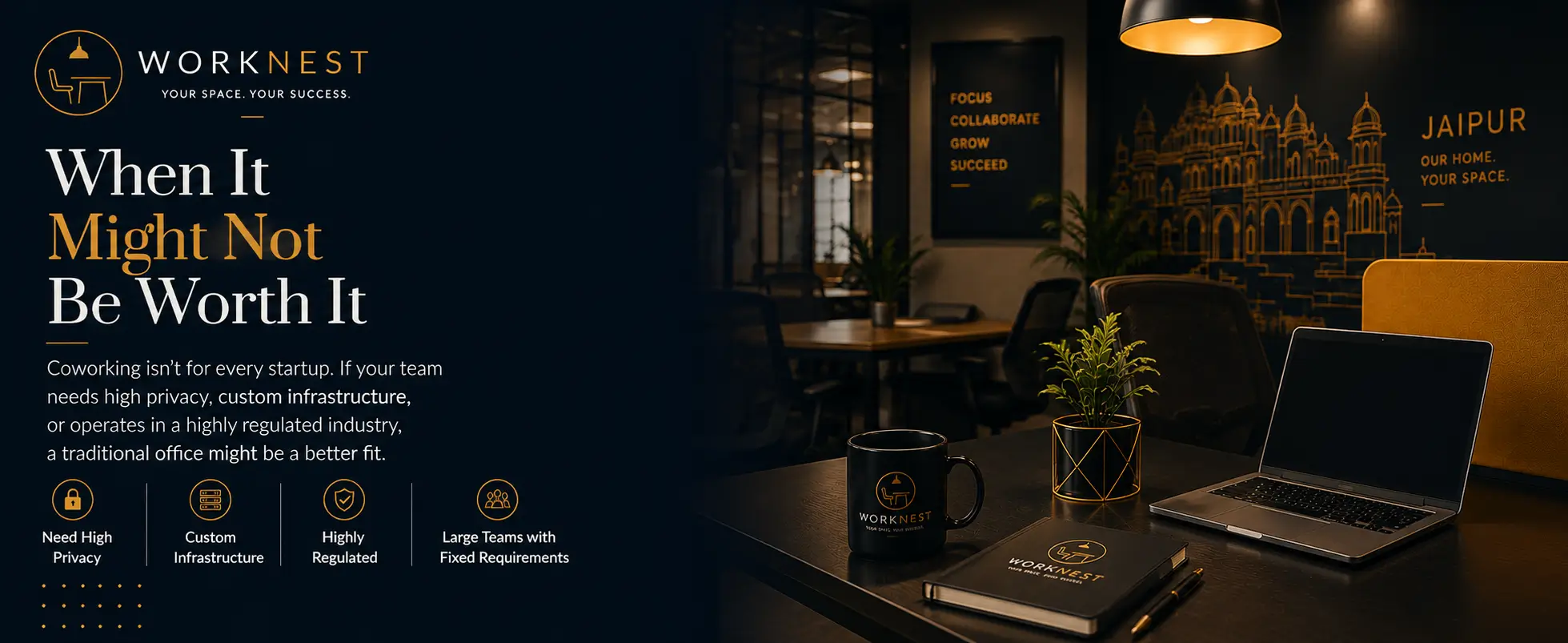
No, coworking is not always the right call. Three situations make a traditional office, or staying remote, the better fit:
You’ve hit 15–20+ people with a stable headcount.
Once hiring plans are confirmed and your team size isn’t expected to swing for 12+ months, the per-desk economics of coworking start to lose their edge over a direct lease, especially if you need a fully custom floor layout.
You need heavy physical infrastructure.
Hardware startups running lab equipment, manufacturing testing, or anything requiring specialized electrical or structural build-outs won’t fit a shared floor plan.
You’re fully remote by design and rarely meet clients in person.
If your team is distributed and client meetings happen over video, a Hot Desk used occasionally may cover your needs – a Dedicated Desk or Private Cabin would be paying for space you don’t use.
If none of these describe your startup, the flexibility and cost case above will likely outweigh the drawbacks.
A Real Example
Aditi Rao, Founder, is one of the 500+ businesses WorkNest has hosted in Mansarovar. Her path reflects the pattern this guide describes: starting small and flexible, then scaling as the team grew, without a lease renegotiation or a locked-in deposit slowing things down.
That kind of named, attributable member outcome carries more weight than a hypothetical case study. It’s also consistent with WorkNest’s 91% renewal rate – most founders who start this way choose to stay rather than move to a traditional lease later.
Note for the WorkNest team: if Aditi Rao has given a specific, publishable quote (e.g., which desk plan she started on, team size at the time, or a direct line about her experience), swap it in here – a verbatim first-hand quote will strengthen this section’s GEO and E-E-A-T value further.
Conclusion
So, is a coworking space worth it for startups? Yes – if your team size is still changing, your cash needs to go into product and payroll rather than deposits and furniture, and you need a professional address without an 11-month commitment. It’s worth a second look only if you’ve already stabilized headcount above 15–20 people or need infrastructure a shared floor can’t offer.
The clearest way to know which side of that line your startup sits on is to walk the space and price it against your actual headcount plan – not a generic estimate.
Ready to see if it fits your team? Book a Free Office Tour at WorkNest, E-3, 6D Engineers Colony, Mansarovar, Jaipur 302020.
FAQs
Q1: Is a coworking space worth it for a 2–3 person startup?
Yes. At this size, a Hot Desk (₹699/day) or a couple of Dedicated Desks (₹9,999/month each) usually costs less per month than the cheapest traditional office lease in Jaipur, with no deposit.
Q2: What’s the real cost difference between coworking and a traditional office in Jaipur?
A 4-person team pays around ₹40,000/month total at WorkNest on Dedicated Desks, versus an estimated ₹35,000–55,000/month rent alone for a small traditional office – before deposit and furniture. (Estimated traditional-office figure – verify before publishing.)
Q3: When should a startup stop coworking and get its own office?
Once headcount is stable above roughly 15–20 people for 12+ months, or the business needs infrastructure a shared floor can’t support (labs, manufacturing, heavy equipment).
Q4: Does WorkNest offer flexible terms for early-stage startups?
Yes. Hot Desks and Dedicated Desks are available monthly with no long-term lease, and Meeting Rooms are billed hourly (₹799/hour) so you only pay when you need client-facing space.
Q5: How fast can a startup scale desks up at WorkNest if it hires quickly?
WorkNest’s team responds to booking and account requests within 30 minutes, which makes adding desks ahead of a new hire’s start date faster than renegotiating a lease.
Q6: Is coworking cheaper than working from home for a startup?
Not necessarily on pure cost, but a coworking space adds a professional address, meeting rooms, and in-person team collaboration – factors that matter once a startup starts meeting clients or investors regularly.
Q7: What does WorkNest’s renewal rate say about long-term value?
WorkNest has a 91% renewal rate among current members, suggesting most teams that try coworking choose to stay rather than switch to a traditional lease.